TL;DR
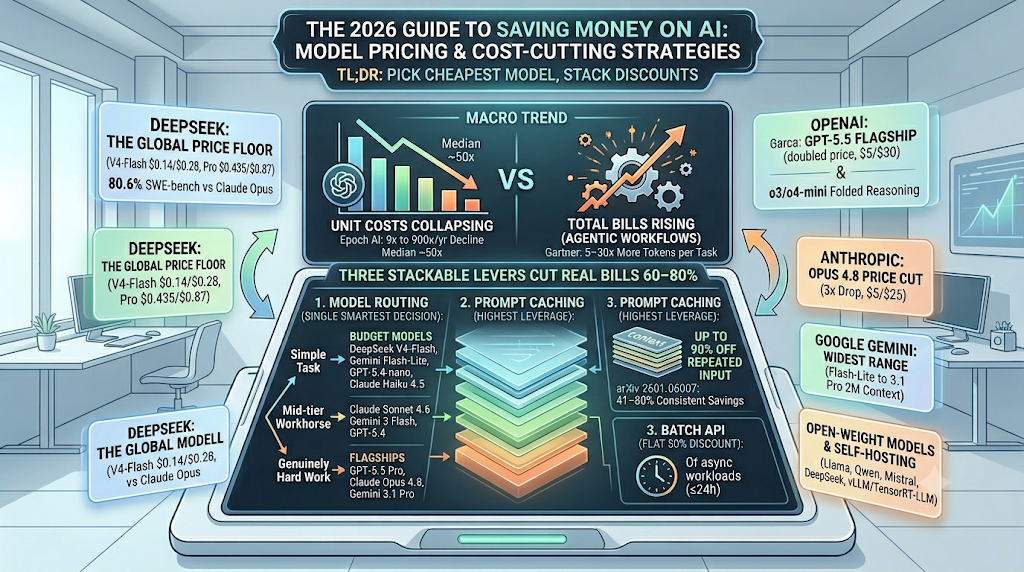
Pick the cheapest model that clears your quality bar, then stack discounts. As of June 2026, frontier-class output ranges from DeepSeek V4-Flash at $0.28/M output up to GPT-5.5 Pro at $180/M; the single smartest decision is routing simple tasks to budget models (DeepSeek, Gemini Flash-Lite, GPT-5.4-nano, Claude Haiku 4.5) and reserving flagships for genuinely hard work.
Three stackable levers cut real bills 60–80%: prompt caching (up to 90% off repeated input), Batch API (a flat 50% off on every major provider), and model routing (sending the right task to the right tier). Free tiers (Google AI Studio, Groq, OpenRouter) and self-hosted open-weight models (Llama, Qwen, DeepSeek, Mistral) push high-volume costs toward zero.
The macro trend is your friend, but watch the paradox: per-token prices for a given capability level are collapsing — Epoch AI measured declines of 9x to 900x per year (median ~50x) across benchmark milestones, while the "Price of Progress" paper pegs frontier capability at ~10x per year. Yet total bills are rising because agentic workflows burn 5–30x more tokens per task, so cost discipline matters more, not less.
Key Findings
OpenAI's flagship is GPT-5.5 at $5/$30 per million input/output tokens (released April 23, 2026), which doubled the price of GPT-5.4 ($2.50/$15). The cheapest current models are GPT-5.4-nano ($0.20/$1.25) and GPT-5.4-mini ($0.75/$4.50). Standalone o3/o4-mini reasoning models are no longer separately priced — reasoning is folded into the GPT-5.x family.
Anthropic's Claude is unusually predictable — every tier holds a 5x output-to-input ratio: Haiku 4.5 ($1/$5), Sonnet 4.6 ($3/$15), Opus 4.8 ($5/$25). Opus dropped from $15/$75 (Opus 4.1) to $5/$25, a 3x flagship price cut.
Google Gemini spans the widest price range — from Gemini 2.5 Flash-Lite ($0.10/$0.40) to Gemini 3.1 Pro ($2/$12, doubling above 200K context). Gemini 3 Flash ($0.50/$3) is the standout value play, and Google AI Studio's free tier is the most generous for prototyping.
DeepSeek remains the global price floor: V4-Flash at $0.14/$0.28 (cache-miss) and V4-Pro at $0.435/$0.87, with cache hits as low as $0.0028/M. V4-Pro scores 80.6% on SWE-bench Verified — within 0.2 points of Claude Opus 4.6's 80.8% — yet per output token it is 28.7x cheaper than Claude Opus 4.8 and 34.5x cheaper than GPT-5.5.
Open-weight models hosted on Groq/Together/DeepInfra cost $0.05–$0.90/M, and self-hosting is free except for compute. The free-tier ecosystem (Groq, OpenRouter, Google AI Studio, Cloudflare) now covers most prototyping and low-volume production.
Details
1. Proprietary model API pricing (USD per 1M tokens, standard tier, June 2026)
OpenAI (verified against official openai.com and developers.openai.com pricing pages, June 21, 2026):
Model | Input | Cached input | Output | Notes |
|---|---|---|---|---|
GPT-5.5 | $5.00 | $0.50 | $30.00 | Flagship; 1M context; long-context (>270K) = $10/$45 |
GPT-5.5 Pro | $30.00 | — | $180.00 | Extended reasoning |
GPT-5.4 | $2.50 | $0.25 | $15.00 | Lower-cost frontier; best cost/quality for most production |
GPT-5.4-mini | $0.75 | $0.075 | $4.50 | Strong mini for coding/subagents |
GPT-5.4-nano | $0.20 | $0.02 | $1.25 | Cheapest; routing/extraction/classification |
GPT-5.3-Codex | $1.75 | $0.175 | $14.00 | Dedicated coding-agent flows |
Batch API = 50% off; Flex ≈ 50% off (variable latency); Priority ≈ 2.5x standard. Cached input is ~90% off the standard input rate. o3/o4-mini standalone inference pricing has been retired; only o3-deep-research ($5/$20) and o4-mini-deep-research ($1/$4) remain listed. Data-residency endpoints carry a +10% uplift.
Anthropic Claude (per Anthropic's pricing docs, May–June 2026):
Model | Input | Output | Notes |
|---|---|---|---|
Claude Opus 4.8 | $5.00 | $25.00 | Flagship (released May 28, 2026); adaptive thinking; Fast Mode $10/$50 |
Claude Opus 4.7 | $5.00 | $25.00 | Vision, long-horizon agents |
Claude Sonnet 4.6 | $3.00 | $15.00 | Recommended default; 1M context at flat rate |
Claude Haiku 4.5 | $1.00 | $5.00 | Cheapest; classification, extraction, summarization |
Batch API = 50% off; prompt-caching cache-hit reads = 0.1x base input (90% off); cache writes cost 1.25x (5-min TTL) or 2x (1-hour TTL). Opus 4.7+ use a new tokenizer that can consume up to 35% more tokens for the same text. (Note: Anthropic released Fable 5 and Mythos 5 on June 9, 2026 but suspended customer access June 12, so they are not currently usable.)
Google Gemini (per Google AI pricing, May–June 2026):
Model | Input | Output | Notes |
|---|---|---|---|
Gemini 3.1 Pro | $2.00 (≤200K) / $4.00 (>200K) | $12.00 / $18.00 | Flagship; up to 2M context |
Gemini 3.5 Flash | $1.50 | $9.00 | Frontier + speed with native grounding |
Gemini 3 Flash | $0.50 | $3.00 | Best value; Pro-grade reasoning at Flash speed (78% SWE-bench) |
Gemini 3.1 Flash-Lite | $0.25 | $1.50 | Cheap, high-volume |
Gemini 2.5 Flash-Lite | $0.10 | $0.40 | Cheapest actively-supported proprietary model |
Batch = 50% off; context caching = 90% off cached reads (+ storage $1–4.50/M/hr). Pro models are no longer on the free tier (since April 1, 2026) — only Flash/Flash-Lite remain free. Long-context (>200K) roughly doubles input price on Pro tiers.
xAI Grok (per docs.x.ai, June 2026):
Model | Input | Output | Notes |
|---|---|---|---|
Grok 4.3 | $1.25 | $2.50 | New flagship (April 30, 2026); unusually cheap output |
Grok 4.20 | $2.00 | $6.00 | Long-context option; cached input ~$0.20 |
Grok 4.1 Fast | $0.20 | $0.50 | 2M context, one of cheapest reasoning models |
Grok 4 | $3.00 | $15.00 | 256K context, live X search grounding |
Batch = 50% off. xAI offers up to ~$150–175/month in free API credits via the data-sharing program. Server-side tools (web/X search, code execution) billed at $5/1K calls.
DeepSeek (official API docs, June 2026):
Model | Input (cache miss) | Input (cache hit) | Output | Notes |
|---|---|---|---|---|
DeepSeek V4-Flash | $0.14 | $0.0028 | $0.28 | High-volume workhorse; 1M context |
DeepSeek V4-Pro | $0.435 | $0.003625 | $0.87 | Best open-weight quality; 80.6% SWE-bench (75%-off promo made permanent May 22, 2026) |
DeepSeek R1 | $0.55 | $0.14 | $2.19 | Reasoning; ~96% cheaper than OpenAI o-series |
Open weights (MIT-style license) mean self-hosting eliminates per-token cost. Cache hits are automatic and free to configure.
Mistral (mistral.ai/pricing, June 2026):
Model | Input | Output | Notes |
|---|---|---|---|
Mistral Large 3 | $0.50 | $1.50 | Flagship; cut 75% from Large 2's $2/$6 |
Mistral Medium 3.5 | ~$0.40 | ~$2.00 | Coding |
Mistral Small 4 | $0.15 | $0.60 | High-volume; 262K context |
Ministral 3B | $0.04 | $0.04 | Cheapest; edge/on-device |
Batch = 50% off. Many models open-weight under Apache 2.0. Le Chat Pro is $14.99/mo (vs ChatGPT Plus $20).
Qwen (Alibaba) (Alibaba Cloud Model Studio, June 2026):
Model | Input | Output | Notes |
|---|---|---|---|
Qwen3.7-Max | $2.50 list / $1.25 promo | $7.50 / $3.75 | Flagship; 1M context |
Qwen-Plus | $0.40 | $1.20 | Mid-tier workhorse |
Qwen-Turbo / Flash | $0.05 | $0.20–$0.40 | Cheapest text tier |
Batch = ~50% off; cache hits ~10% of standard. Free developer API tier discontinued April 15, 2026, but new accounts get ~70M tokens free for 90 days. Open-weight Qwen3 models are Apache 2.0 and free to self-host. Consumer Qwen Chat app is free.
Meta Llama (open-weight; hosted prices via third parties, 2026):
Model / host | Input | Output | Notes |
|---|---|---|---|
Llama 3.3 70B (DeepInfra) | $0.23 | $0.40 | Cheapest host |
Llama 3.3 70B (Groq) | $0.59 | $0.79 | Fastest (250+ tok/s) |
Llama 4 Maverick (DeepInfra) | $0.15 | $0.60 | MoE, big cost advantage |
Llama 3.1 8B (Groq) | $0.05 | $0.05 | Cheapest overall |
Meta does not run a first-party API; weights are free under the Llama Community License (below 700M MAU).
2. Free tier and budget options
Free chat interfaces: ChatGPT free (GPT-5.4-mini + limited flagship), Claude.ai free (~30–100 messages/day), Gemini free (Gemini 2.5/3 Flash), Grok free via X, Qwen Chat, DeepSeek chat (fully free, V4-Pro Expert Mode — there is no paid "Plus" tier).
Free API tiers: Google AI Studio (Flash/Flash-Lite, ~1,500 RPD; Pro no longer free); Groq (open-weight only, ~14,400 RPD on 8B, ~1,000 RPD on 70B, no credit card); OpenRouter (28+ free
:freemodels incl. DeepSeek R1, Llama, Qwen3-Coder; 20 RPM / 50–1,000 RPD); Cloudflare Workers AI (10,000 free Neurons/day); Hugging Face Serverless (200K+ models, <10B on free tier).Self-hosting (compute-only cost): Llama, Qwen3, DeepSeek, Mistral, Phi, Gemma via Ollama/vLLM. Breakeven vs API typically at tens of millions of tokens/day. A 27B model needs ~$1,600–2,000 in GPU hardware. Llama 4 Scout fits one H100 80GB at INT4; Llama 3.1 8B runs on ~5GB VRAM.
3. Cost-saving strategies
Prompt caching — the highest-leverage, lowest-risk lever. Cache reads cost ~10% of base input across Anthropic, OpenAI, Google, DeepSeek, Qwen. The academic study "Don't Break the Cache: An Evaluation of Prompt Caching for Long-Horizon Agentic Tasks" (arXiv 2601.06007, Jan 2026) found that caching only the system prompt (not dynamic tool results) produced the most consistent savings, in the 41–80% range across providers, with savings scaling linearly with prompt size (10–45% at 500 tokens up to 54–89% at 50,000 tokens). Order prompts so static content (tools, system prompt, docs) comes first and volatile content (timestamps, user query) last. Warning: naive full-context caching can paradoxically raise latency.
Batch API — flat 50% discount on OpenAI, Anthropic, Google, xAI, Mistral, Qwen, Groq for async (≤24h) workloads. Stacks with caching: a cached batch request can cost ~5% of a standard call.
Model routing / tiering — the single biggest lever. Route ~70% of simple tasks to budget models, ~20% mid-tier, ~10% to flagships. Tools: OpenRouter Auto Router (powered by NotDiamond, with a
cost_quality_tradeoffdial from 0 to 10, default 7, no surcharge — the 5% credit markup is waived with BYOK), Martian, NotDiamond, LiteLLM (self-hosted), Portkey (open-sourced under Apache 2.0 in March 2026), Cloudflare AI Gateway, Azure AI Foundry Model Router. Routing can cut costs 40–80%.Use smaller/distilled models — Haiku 4.5 hits 90% of Sonnet 4's coding quality at one-third the cost; Gemini 3 Flash beats 2.5 Pro on SWE-bench at a fraction of the price. Don't pay flagship rates for classification.
Context management — trim history, avoid dumping whole documents, and beware the 200K-context "cliff" on Gemini Pro and OpenAI long-context tiers where prices roughly double. Cap output with max_tokens (output costs 5–6x input).
RAG vs long context — retrieval over a focused chunk is usually far cheaper than stuffing a 1M-token context on every call; combine with caching of stable corpora.
Self-host for high volume — at scale, open-weight models on your own GPUs (vLLM/TensorRT-LLM with continuous batching) beat per-token API pricing.
4. Best models by use case (cost-effectiveness)
Simple chat / FAQ / classification / extraction: Gemini 2.5 Flash-Lite ($0.10/$0.40), GPT-5.4-nano ($0.20/$1.25), DeepSeek V4-Flash, Claude Haiku 4.5, Mistral Small 4.
Customer support automation (RAG): Claude Sonnet 4.6 or Gemini 3 Flash with prompt caching + RAG; route easy tickets to Haiku/Flash-Lite.
Coding assistance: DeepSeek V4-Pro (best value), Claude Opus 4.8 / Sonnet 4.6 (quality), GPT-5.3-Codex, Gemini 3 Flash (78% SWE-bench at low cost).
Long-document summarization: Gemini 3.1 Pro (2M context) or Grok 4.1 Fast (2M, $0.20/$0.50); batch + cache for volume.
Content writing: Mistral Large 3 (cheapest output in tier), Claude Sonnet 4.6, GPT-5.4.
Data extraction: Gemini Flash-Lite or GPT-5.4-nano with structured/JSON output; DeepSeek for multilingual.
Image generation: Imagen 4 Fast ($0.02/image, cheapest official), GPT Image 1-mini ($0.005–0.009/image), Gemini 3 Flash Image / Nano Banana 2 ($0.067/1K), GPT Image 1.5 ($0.04, quality leader), Nano Banana Pro ($0.134/2K, $0.24/4K, premium). Batch cuts image costs 50%.
5. Notable 2026 trends
Inference price collapse: Epoch AI ("LLM inference prices have fallen rapidly but unequally across tasks," Mar 2025) measured per-token cost declines of 9x to 900x per year, with a median of 50x across benchmark milestones (effectively halving every ~2 months at fixed quality); the "Price of Progress" paper (arXiv 2511.23455, Nov 2025) pegs frontier capability at ~10x/year. GPT-4-class capability fell from ~$30/M in 2023 to under $1/M.
The DeepSeek shock: DeepSeek made its 75%-off V4-Pro promo permanent on May 22, 2026, delivering near-Opus coding quality (80.6% vs 80.8% SWE-bench) at 28.7x lower output cost than Claude Opus 4.8.
The paradox: unit costs fall while total bills rise. Per Gartner (March 2026), agentic AI requires 5–30x more tokens per task than standard chatbots, with a single user request often triggering 10–20 LLM calls. Deloitte's 2026 TMT Predictions states inference will make up two-thirds of AI compute by 2026 (up from a third in 2023 and half in 2025). FinOps-for-AI (routing, caching, budgets) is now standard practice.
GPT-5.5 bucked the deflation by doubling GPT-5.4's price, betting that token-efficiency offsets the higher sticker rate — the only major upward move in the market.
Open-weight models closed the gap: DeepSeek, Qwen, GLM, MiniMax, and Kimi now rival proprietary frontier models on coding benchmarks at 15–60x lower cost.
Context windows ballooned to 1M–2M tokens across the board, but long-context pricing tiers mean bigger isn't always cheaper.
Recommendations
Start free, prove value, then scale. Prototype on Google AI Studio, Groq, or OpenRouter free tiers. Validate model quality on your actual task with 100–200 test cases before paying.
Default to mid-tier, escalate deliberately. Make Claude Sonnet 4.6, Gemini 3 Flash, or GPT-5.4 your workhorse; reserve Opus 4.8 / GPT-5.5 / Gemini 3.1 Pro for tasks where quality has direct revenue impact.
Implement the three levers in order: (a) prompt caching first (lowest effort, 41–80% savings on repeated context), (b) batch processing for anything async (flat 50%), (c) model routing once your bill is large enough to justify an eval pipeline.
Benchmark DeepSeek V4 and hosted open-weight models for high-volume, cost-sensitive work — but route sensitive data through a compliant host (AWS Bedrock, Azure) given DeepSeek and Qwen are Chinese-hosted on the direct API.
For >10M tokens/day of stable workload, evaluate self-hosting open-weight models on your own GPUs.
Thresholds that change the plan: If monthly API spend crosses ~$100, start optimizing (caching). At several thousand $/month, add routing plus a gateway. If a single workload exceeds tens of millions of tokens/day, model self-hosting. If output quality degrades after routing to a cheaper model (watch customer tickets), add an eval gate of 50–500 cases before each routing change.
Caveats
Pricing changes constantly. All figures are as of June 2026 from provider pricing pages and reputable trackers; verify on the official page before budgeting. Several third-party trackers disagree on minor versions and promotional prices.
Headline token price ≠ real bill. Reasoning/thinking models emit many hidden "thinking" tokens; agentic loops multiply token use (5–30x); tool calls and long-context tiers add charges. Measure cost-per-accepted-output, not sticker price.
Free tiers are not production-grade. Rate limits, deprioritization during peak load, possible data-training opt-ins, and sudden quota changes apply. Don't build production dependencies on free tiers.
Some sources are speculative or promotional. A few cited blogs forecast future price normalization (the "subsidized floor" argument that VC-funded inference prices may rise 12–24 months out) — treat as analyst opinion, not fact. Anthropic's Fable 5 / Mythos 5 were launched then suspended within days, illustrating volatility.
Quality gaps persist. Even mid-2026 open-weight models trail Claude Sonnet 4.6 / GPT-5.4 on the hardest reasoning, nuanced writing, and multi-step coding — the gap is narrower than before, but real.